
For Nothern Arc Development....
Click Here
And Here
Rob
Wednesday, 18 April 2012


Sunday, 15 April 2012
Wild Boar in the Forest of Dean
Had an eventful couple of weeks with the wild boar as they start to become more active with their little ones.
The vast majority of wild boar births happen between late February to early March after a gestation period of around 4 months and this is a good time to see them as the little ones are very active, learning the ways of the world from mum.
This is the first year that they have been given the luxury of a closed season and this is vital as the piglets are dependant on the sows milk for around 3 to 4 months. Along with two colleagues, I actively campaigned for a closed season from January to June/July so that the young ones have a chance at life, but the main reason is that if a sow is shot, the little ones will starve to death without the support from the sow.
The Forestry Commission agreed to this, but instead of resuming the cull as and when the piglets are independent and able to survive on their own, they have chosen to suspend and review the cull in September.
There is a reason behind this and I hope that it isn't to try and discredit me and my colleagues as we will see a big increase in boar numbers between now and September as the little ones grow and venture further afield.
Whatever the reason I still stand by the fact that it is immoral to kill an animal with dependant young!
Its not always easy spotting the boar and this was my first glimpse of a sounder (group) after at least 5 miles of tracking.

Seeing them is one thing, but getting close to get a decent shot is another! I was creeping up to get a better look at the sow when I noticed movement in the reeds. A piglet was staring straight at me and this is usually where it all goes wrong as they give you away in an instant.

I was low to the ground, out of sight of the sow and it was just a case of waiting to see if the sow would either ignore the piglet, or come and investigate.
She came to investigate!

After watching me through the trees for a while she decided to come up for a better look!

Then she heard passers and also realising I was human she rounded up her young, disappearing into the forest.

I moved on to try and track down some more in a different location and it wasn't long before the tell tale signs started showing.
Boar poo - I try not to lye and roll around in this!

Then all of a sudden a sow stood up right in front of me!

I crouched down out of sight, but it was too late and she was gone. I was gutted, but when they are lying down in the bracken its very tough knowing they are there until its too late.
I decided to stay in the area for around an hour when all of a sudden I heard movement in the forest and it sounded heavy. I crouched behind a tree and watched as two sows and around 7 - 8 piglets came out into the open.
The sow knew I was there, but she must have decided that I was no threat and brought her little ones out to show me.

I decided to go back to this location today and sure enough, within 10 minuets I found them again. This time the sow saw me from the start, but as I kept my distance and crept up slowly she didn't seem to mind.
Its fantastic being in the presence of the wild boar and to be able to sit within a metre of them and their young while they are acting perfectly natural is a real treat.
Pics from today...


Respect these animals and their home and ypu can have some truly memorable experiences being around them.
PS: I didn't take my dog!
Rob
The vast majority of wild boar births happen between late February to early March after a gestation period of around 4 months and this is a good time to see them as the little ones are very active, learning the ways of the world from mum.
This is the first year that they have been given the luxury of a closed season and this is vital as the piglets are dependant on the sows milk for around 3 to 4 months. Along with two colleagues, I actively campaigned for a closed season from January to June/July so that the young ones have a chance at life, but the main reason is that if a sow is shot, the little ones will starve to death without the support from the sow.
The Forestry Commission agreed to this, but instead of resuming the cull as and when the piglets are independent and able to survive on their own, they have chosen to suspend and review the cull in September.
There is a reason behind this and I hope that it isn't to try and discredit me and my colleagues as we will see a big increase in boar numbers between now and September as the little ones grow and venture further afield.
Whatever the reason I still stand by the fact that it is immoral to kill an animal with dependant young!
Its not always easy spotting the boar and this was my first glimpse of a sounder (group) after at least 5 miles of tracking.

Seeing them is one thing, but getting close to get a decent shot is another! I was creeping up to get a better look at the sow when I noticed movement in the reeds. A piglet was staring straight at me and this is usually where it all goes wrong as they give you away in an instant.
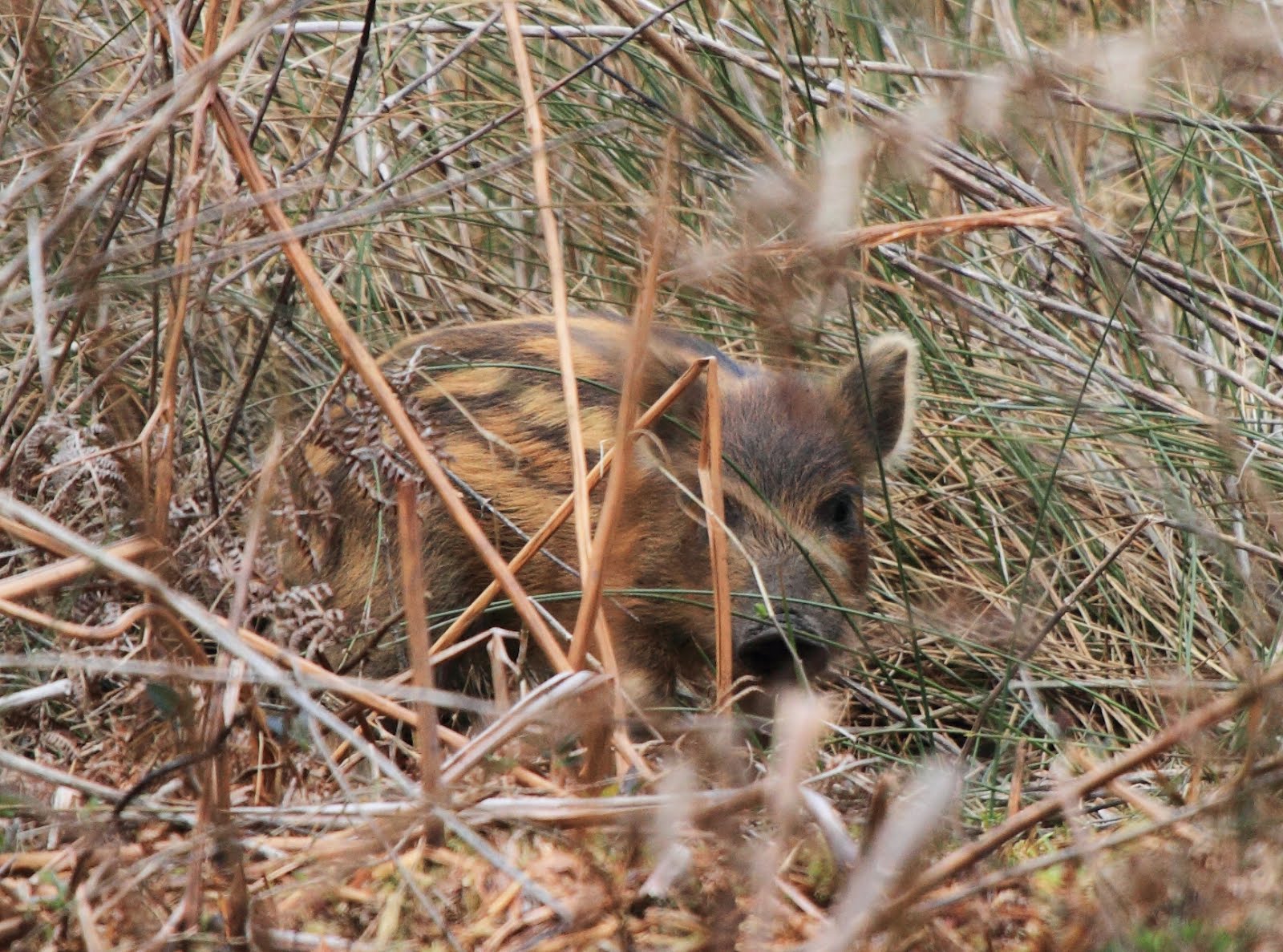
I was low to the ground, out of sight of the sow and it was just a case of waiting to see if the sow would either ignore the piglet, or come and investigate.
She came to investigate!

After watching me through the trees for a while she decided to come up for a better look!

Then she heard passers and also realising I was human she rounded up her young, disappearing into the forest.

I moved on to try and track down some more in a different location and it wasn't long before the tell tale signs started showing.
Boar poo - I try not to lye and roll around in this!

Then all of a sudden a sow stood up right in front of me!

I crouched down out of sight, but it was too late and she was gone. I was gutted, but when they are lying down in the bracken its very tough knowing they are there until its too late.
I decided to stay in the area for around an hour when all of a sudden I heard movement in the forest and it sounded heavy. I crouched behind a tree and watched as two sows and around 7 - 8 piglets came out into the open.
The sow knew I was there, but she must have decided that I was no threat and brought her little ones out to show me.

I decided to go back to this location today and sure enough, within 10 minuets I found them again. This time the sow saw me from the start, but as I kept my distance and crept up slowly she didn't seem to mind.
Its fantastic being in the presence of the wild boar and to be able to sit within a metre of them and their young while they are acting perfectly natural is a real treat.
Pics from today...


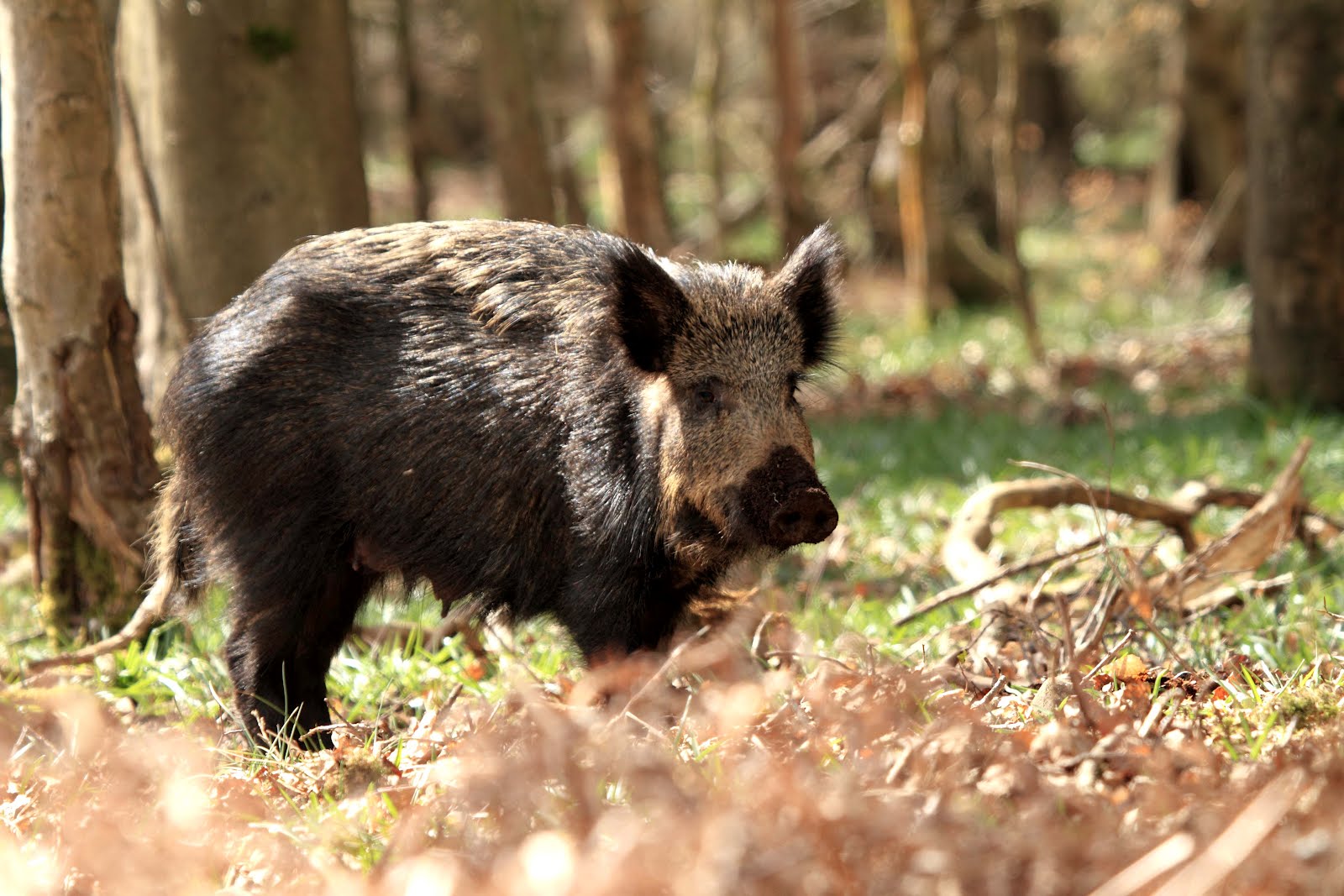

Respect these animals and their home and ypu can have some truly memorable experiences being around them.
PS: I didn't take my dog!
Rob
Saturday, 7 April 2012
Northern Arc - Part 2
To follow on from my last post regarding the proposed development (Northern Arc) at the Northern United site near Steam Mills, I have given you some facts below as well as highlighting some of the reasons why I feel this site is unsuitable for development.
There are links at the bottom of the post if you wish to aire your views and support.
______________________________________________
Firstly, Northern United is the last remaining deep mine in the Forest of Dean and the surrounding area (proposed development site) is riddled with old mines and chambers. The area has been prone to flooding in the past and this, coupled with the unstable ground will cause major problems in the future due to subsidence and ground collapses.
I am not an expert on mining like my father, so I will not elaborate on this, but I come from a mining family with my father working all the pits throughout the Forest of Dean when he was young (Northern United included). My grandfather also worked the mines and my great grandfather lost a leg in a Forest pit at the age of 15!
The Northern United pit buildings, including bath house are an eyesore, but why are they an eyesore? They have been left derelict, with the surrounding area fenced off to the general public and this area is now overgrown with brambles etc. This is the reason it is an eyesore, but this site should not have been earmarked for demolition because of our unwillingness to preserve it.
The news that these buildings are to be demolished to make way for a road is very unsettling as it is of the utmost importance that these buildings are kept intact and restored so that the young people of today understand and realise the struggles that their ancestors went through to put bread on the table. Of course we must move forward, but at what cost? We must “never” forget our past as it is this history, which made us and our communities what they are today.
As you are aware, the Forest of Dean was formally a Royal Hunting ground and it is steeped in history, heritage and culture, all of which is now under threat.
The Forest of Dean is a very special place for local people and visitors alike. This is why we fought so hard to save our forest; our biggest asset, from the threat of commercialisation and development. However, we are now facing another threat called the Northern Quarter Area Action Plan or (Northern Arc Project), which will undermine all of the hard work and see hundreds of acres of woodland and unique habitats destroyed. Many local council leaders apposed the sale of our forest and fought hard, along with the community to safeguard our most valuable asset, yet today these same people are the ones pushing forward with plans to destroy it!
Phase one of the Cinderford Northern Quarter Area Action Plan or (Northern Arc Project) will see a Spine Road slicing through the heart of the forest. The proposed road is to be street fronted with built development along the majority of its length and if implemented, the road will isolate a large proportion of the forest for future development. More than 1,000 new homes are planned to be built over the next 10 years. It will mean the loss of many historic oak trees planted under the instructions of Lord Nelson, as well as other hard wood trees and unique, ancient habitats.
Phase two will see a hotel, 175 residential houses and offices being built along the main Spine Road.
Phase three will see more residential housing and offices built around an idyllic lake, which supports a massive variety of wildlife, including very rare endangered species like the otter, water vole and great crested newt.
With the shortage of work in the area I can not see the logic in erecting over 1,000 new homes, as we will then see a massive explosion of people requiring employment in the area. The potential initial increase of 300 to 400 cars will then build up to around 1,500 to 2,000 in an area that’s road infrastructure can hardly cope now and it will be an environmental nightmare.
The main build area consists of open land as well as unique habitats, which supports a wide variety of endangered species. Of these wildlife species many are on the Red List for protection and the area has been surveyed by professionals. During the surveys, all endangered species except one were found, yet the plans are still being pushed through, why?
To see a list of the endangered species present at this site, see my previous post.
I am "NOT" against plans to regenerate Cinderford and I applaud the hard work put in by the many who have visioned this. However, Northern United, with its history, wildlife and unique habitats is probably the worst place they could have picked.
To some it may look like an eyesore, but that all depends how you are looking upon it. For me and I know I speak for many, this site is not ugly, it is undisturbed and this is what our wildlife requires today. A place where they feel safe.
Doesn't anyone give a damn about our wildlife anymore? Why do we have to keep fighting to save it from the clowns with blinkers on?
Some links for you, if you wish to help save this site. Please help or one day it may be too late when our forest is covered with tarmac and concrete!
Woodwatch
Save Our Forests
I also advise all to write to the Forest of Dean District Council, MP Mark Harper and David Cameron to raise your concerns and appose these plans.
Will keep you updated.
Rob
There are links at the bottom of the post if you wish to aire your views and support.
______________________________________________
Firstly, Northern United is the last remaining deep mine in the Forest of Dean and the surrounding area (proposed development site) is riddled with old mines and chambers. The area has been prone to flooding in the past and this, coupled with the unstable ground will cause major problems in the future due to subsidence and ground collapses.
I am not an expert on mining like my father, so I will not elaborate on this, but I come from a mining family with my father working all the pits throughout the Forest of Dean when he was young (Northern United included). My grandfather also worked the mines and my great grandfather lost a leg in a Forest pit at the age of 15!
The Northern United pit buildings, including bath house are an eyesore, but why are they an eyesore? They have been left derelict, with the surrounding area fenced off to the general public and this area is now overgrown with brambles etc. This is the reason it is an eyesore, but this site should not have been earmarked for demolition because of our unwillingness to preserve it.
The news that these buildings are to be demolished to make way for a road is very unsettling as it is of the utmost importance that these buildings are kept intact and restored so that the young people of today understand and realise the struggles that their ancestors went through to put bread on the table. Of course we must move forward, but at what cost? We must “never” forget our past as it is this history, which made us and our communities what they are today.
As you are aware, the Forest of Dean was formally a Royal Hunting ground and it is steeped in history, heritage and culture, all of which is now under threat.
The Forest of Dean is a very special place for local people and visitors alike. This is why we fought so hard to save our forest; our biggest asset, from the threat of commercialisation and development. However, we are now facing another threat called the Northern Quarter Area Action Plan or (Northern Arc Project), which will undermine all of the hard work and see hundreds of acres of woodland and unique habitats destroyed. Many local council leaders apposed the sale of our forest and fought hard, along with the community to safeguard our most valuable asset, yet today these same people are the ones pushing forward with plans to destroy it!
Phase one of the Cinderford Northern Quarter Area Action Plan or (Northern Arc Project) will see a Spine Road slicing through the heart of the forest. The proposed road is to be street fronted with built development along the majority of its length and if implemented, the road will isolate a large proportion of the forest for future development. More than 1,000 new homes are planned to be built over the next 10 years. It will mean the loss of many historic oak trees planted under the instructions of Lord Nelson, as well as other hard wood trees and unique, ancient habitats.
Phase two will see a hotel, 175 residential houses and offices being built along the main Spine Road.
Phase three will see more residential housing and offices built around an idyllic lake, which supports a massive variety of wildlife, including very rare endangered species like the otter, water vole and great crested newt.
With the shortage of work in the area I can not see the logic in erecting over 1,000 new homes, as we will then see a massive explosion of people requiring employment in the area. The potential initial increase of 300 to 400 cars will then build up to around 1,500 to 2,000 in an area that’s road infrastructure can hardly cope now and it will be an environmental nightmare.
The main build area consists of open land as well as unique habitats, which supports a wide variety of endangered species. Of these wildlife species many are on the Red List for protection and the area has been surveyed by professionals. During the surveys, all endangered species except one were found, yet the plans are still being pushed through, why?
To see a list of the endangered species present at this site, see my previous post.
I am "NOT" against plans to regenerate Cinderford and I applaud the hard work put in by the many who have visioned this. However, Northern United, with its history, wildlife and unique habitats is probably the worst place they could have picked.
To some it may look like an eyesore, but that all depends how you are looking upon it. For me and I know I speak for many, this site is not ugly, it is undisturbed and this is what our wildlife requires today. A place where they feel safe.
Doesn't anyone give a damn about our wildlife anymore? Why do we have to keep fighting to save it from the clowns with blinkers on?
Some links for you, if you wish to help save this site. Please help or one day it may be too late when our forest is covered with tarmac and concrete!
Woodwatch
Save Our Forests
I also advise all to write to the Forest of Dean District Council, MP Mark Harper and David Cameron to raise your concerns and appose these plans.
Will keep you updated.
Rob
Saturday, 31 March 2012
Maybe Next Time?
After around 3hrs of tracking in an area where I knew there were wild boar, I finally found them.
I hadn't seen or heard a single person and felt great as I managed to get into a fantastic position to grab some good shots.
Focusing on a open area where the sun was dappled on the forest floor as it cut through the trees, all I needed was for the boar to move into this area. This is where patience comes in as it is so easy to push to get close, which usually ends up with the wildlife being disturbed and you then miss your chance. It can take a while, but being patient usually gets you better results.
Then I heard voices in the distance and I was praying that they weren't coming my way, but they were. Out of the whole forest, two guys had decided to walk directly where I was camped out; I couldn't believe it!
I could picture the shots I was about to get, but instead all I ended up with was these.
This is the moment she heard them and rallied her young.

Then they disappeared into a dense part of the forest.

Talk about gutted, but that's how it goes sometimes. The sow was by far one of the largest I have seen for a few years and she would have made a great photograph; along with her little ones. I will find them again and hopefully I/we won't be disturbed next time.
Rob
I hadn't seen or heard a single person and felt great as I managed to get into a fantastic position to grab some good shots.
Focusing on a open area where the sun was dappled on the forest floor as it cut through the trees, all I needed was for the boar to move into this area. This is where patience comes in as it is so easy to push to get close, which usually ends up with the wildlife being disturbed and you then miss your chance. It can take a while, but being patient usually gets you better results.
Then I heard voices in the distance and I was praying that they weren't coming my way, but they were. Out of the whole forest, two guys had decided to walk directly where I was camped out; I couldn't believe it!
I could picture the shots I was about to get, but instead all I ended up with was these.
This is the moment she heard them and rallied her young.

Then they disappeared into a dense part of the forest.

Talk about gutted, but that's how it goes sometimes. The sow was by far one of the largest I have seen for a few years and she would have made a great photograph; along with her little ones. I will find them again and hopefully I/we won't be disturbed next time.
Rob
Tuesday, 27 March 2012
Cinderford Northern Arc Development = Disaster for Wildlife!
This is of great importance to all local people and also to those who care for our habitats and wildlife. I advise you to read carefully and do whatever you can to help.
When you read or hear the name Ark, what do you think of? Maybe a guy called Noah who helped save all living creatures of this planet.
Well there is another Ark on its way, but this time it is not coming to save and protect; instead it is coming to disturb and destroy!
If the Cinderford Northern Arc Project gets the green light its footprint will cause unimaginable, untold damage to the proposed area at Steam Mills, near Cinderford. An area that supports key habitat to many endangered species, including Red List species.
I have personally seen many of the very rare and endangered species at this site and the few, which I haven't seen have been recorded by trusted sources, like the Forest Green Team who recorded an otter as far back as 2007.
Due to (c) laws, I can not show you a photograph I obtained from the FoDDC, detailing the vast area that is to be developed. However, I can tell you that it is massive and will see a road cutting right through the forest and it will also see an area that is rich in undisturbed wildlife destroyed!
I can give you the location on Google Maps - Click Here
The main development site around Steam Mills Lake supports a varied and healthy abundance of rare wildlife and I can't think of another site throughout the Forest of Dean, which is richer in varied wildlife.
Some of the wildlife in this area is on the Red List for protection and the majority of these species "HAVE" been recorded during area surveys; authorised and carried out by professionals for the Regeneration Board.
To name just a few, this site supports....
Lesser Horseshoe Bat
Greater Horseshoe Bat
Great Crested Newt
Adder
Hawfinch
Otter
Doormouse
Water Vole
One species named above, which was not recorded in the surveys is the Hawfinch. This bird is so rare and endangered in the UK that only 5,000 breeding pairs are present throughout the whole country. This bird is on the Red List and its conservation Status is as follows.
• Globally threatened
• Historical population decline in UK during 1800–1995
• Severe (at least 50%) decline in UK breeding population over last 25 years, or longer-term period (the entire period used for assessments since the first BoCC review, starting in 1969).
• Severe (at least 50%) contraction of UK breeding range over last 25 years, or the longer-term period
The Hawfinch has been ringed at this site for many years and the Forestry Commission are aware of this, so I can't see how this has been overlooked.
With rare bats, birds, amphibians, reptiles, mammals and insects present at this site; I am stunned that they are still going ahead with their plans to bulldoze right through the middle of it!
The area is also very popular with fishermen and dog walkers; all of whom will lose the area if these plans go ahead.
To see a full list of identified wildlife species found during the surveys click below.
Click here for the results from the Field Survey
The "Spine Road" will cut through the forest leaving a part of the forest isolated between the Spine Road and Steam Mills/Hawkwell. I have asked the question "what guarantees do we have that this isolated woodland "will not" also be developed in the years to come?"
I didn't get a reply to that one!
Encroachment will see even more habitats and wildlife suffer and where will it stop?
I agree that Cinderford requires regeneration as it is staring to become a ghost town, but I can't see how developing an area so far out of the actual town will help. Maybe they should look at the "actual town" and inject some much needed revenue there before creating another "Mini-Cinderford" on the outskirts.
I sincerely hope that this isn't happening so that certain people can retire and leave their legacy behind. One legacy, which would be appreciated and which would always be recognised, is if this area along with the rest of our most valuable asset was protected and preserved.
I know which one I would want to be remembered for!
Some links below.
Cinderford Area Action Plan - Evidence Base
Take a look at the photograph on the front of THIS REPORT. It may not look like this for very much longer!
A Recent Article - HERE
(Just something personal from me)
It wasn't very long ago that the HooF campaign fought to save OUR forests and yet this seems to be the exact thing they were trying to prevent. I wonder why this seems to have been accepted? Lets face it, if other areas are encroached upon like this, throughout the Forest of Dean area, then the fight to safeguard our forest will have been for nothing!
Why not turn this area into a nature reserve as this will help bring tourists into the area. People do not visit the Forest of Dean just to stay in a hotel, they visit to walk our forest and to hopefully see the wildlife therein. The Forest is our most valuable asset.
Rob
When you read or hear the name Ark, what do you think of? Maybe a guy called Noah who helped save all living creatures of this planet.
Well there is another Ark on its way, but this time it is not coming to save and protect; instead it is coming to disturb and destroy!
If the Cinderford Northern Arc Project gets the green light its footprint will cause unimaginable, untold damage to the proposed area at Steam Mills, near Cinderford. An area that supports key habitat to many endangered species, including Red List species.
I have personally seen many of the very rare and endangered species at this site and the few, which I haven't seen have been recorded by trusted sources, like the Forest Green Team who recorded an otter as far back as 2007.
Due to (c) laws, I can not show you a photograph I obtained from the FoDDC, detailing the vast area that is to be developed. However, I can tell you that it is massive and will see a road cutting right through the forest and it will also see an area that is rich in undisturbed wildlife destroyed!
I can give you the location on Google Maps - Click Here
The main development site around Steam Mills Lake supports a varied and healthy abundance of rare wildlife and I can't think of another site throughout the Forest of Dean, which is richer in varied wildlife.
Some of the wildlife in this area is on the Red List for protection and the majority of these species "HAVE" been recorded during area surveys; authorised and carried out by professionals for the Regeneration Board.
To name just a few, this site supports....
Lesser Horseshoe Bat
Greater Horseshoe Bat
Great Crested Newt
Adder
Hawfinch
Otter
Doormouse
Water Vole
One species named above, which was not recorded in the surveys is the Hawfinch. This bird is so rare and endangered in the UK that only 5,000 breeding pairs are present throughout the whole country. This bird is on the Red List and its conservation Status is as follows.
• Globally threatened
• Historical population decline in UK during 1800–1995
• Severe (at least 50%) decline in UK breeding population over last 25 years, or longer-term period (the entire period used for assessments since the first BoCC review, starting in 1969).
• Severe (at least 50%) contraction of UK breeding range over last 25 years, or the longer-term period
The Hawfinch has been ringed at this site for many years and the Forestry Commission are aware of this, so I can't see how this has been overlooked.
With rare bats, birds, amphibians, reptiles, mammals and insects present at this site; I am stunned that they are still going ahead with their plans to bulldoze right through the middle of it!
The area is also very popular with fishermen and dog walkers; all of whom will lose the area if these plans go ahead.
To see a full list of identified wildlife species found during the surveys click below.
Click here for the results from the Field Survey
The "Spine Road" will cut through the forest leaving a part of the forest isolated between the Spine Road and Steam Mills/Hawkwell. I have asked the question "what guarantees do we have that this isolated woodland "will not" also be developed in the years to come?"
I didn't get a reply to that one!
Encroachment will see even more habitats and wildlife suffer and where will it stop?
I agree that Cinderford requires regeneration as it is staring to become a ghost town, but I can't see how developing an area so far out of the actual town will help. Maybe they should look at the "actual town" and inject some much needed revenue there before creating another "Mini-Cinderford" on the outskirts.
I sincerely hope that this isn't happening so that certain people can retire and leave their legacy behind. One legacy, which would be appreciated and which would always be recognised, is if this area along with the rest of our most valuable asset was protected and preserved.
I know which one I would want to be remembered for!
Some links below.
Cinderford Area Action Plan - Evidence Base
Take a look at the photograph on the front of THIS REPORT. It may not look like this for very much longer!
A Recent Article - HERE
(Just something personal from me)
It wasn't very long ago that the HooF campaign fought to save OUR forests and yet this seems to be the exact thing they were trying to prevent. I wonder why this seems to have been accepted? Lets face it, if other areas are encroached upon like this, throughout the Forest of Dean area, then the fight to safeguard our forest will have been for nothing!
Why not turn this area into a nature reserve as this will help bring tourists into the area. People do not visit the Forest of Dean just to stay in a hotel, they visit to walk our forest and to hopefully see the wildlife therein. The Forest is our most valuable asset.
Rob
Tuesday, 13 March 2012
A Trip Down South!
Along with a good friend (who was driving) I endured horrendous traffic, which meant it took four hours to reach our destination in Dorset and with heavy fog most of the way it appeared that we would probably be travelling back without the photographs we were after.
However, optimistic as always and nearing our location the sun broke through the fog and it turned into the perfect day for the rare reptile species we were after; the Sand Lizard!
NOTE: The Sand Lizard is protected under, Schedule 2 of the Conservation (Natural Habitats, etc.) Regulations (1994), and Schedule 5 of the Wildlife and Countryside Act, 1981.
With the help of some very trusting and friendly locals, it was only a few minuets before I was face to face with my first sand lizard. I must admit that I was shocked to have found one so quickly, but without the help of our local friends it would have taken a lot longer as they are so well camouflaged.
First find!

This was great, except it was not the best of shots due to the bush it was basking under, so we moved on.
I had never seen a sand lizard in the wild before, so as far as I was concerned this was about as good as it was going to get. How wrong I was as just around the corner our luck changed!
This fella was out in the open making the most of the blazing sun!

There were at least six lizards in one location and it was hard picking one to photograph.

The one thing that astounded me was the fact that they were all very curious and even came up to the camera!
The sand lizard, as mentioned above, is very rare and also extremely protected so the last thing I wanted to do was to disturb them. This concerned me on the way to Dorset, but I was gobsmacked at how relaxed these lizards were with our presence.

It's always nice to get two different species in one shot, but when I got up on this morning I couldn't of imagined that I would be photographing a sand lizard, with a ladybird walking around next to him!

We left this site and headed out onto some heathland where we saw a nice male adder. I missed this opportunity, but something even more special was just around the corner.
A male sand lizard!

We left the locals and headed to another spot where there was a chance of photographing another species, which I had not captured previously; Sika Deer.
Not knowing what to expect and ready for the stalk I followed my friend to some open grassy areas, surrounded by woodland. Now these deer are wild, they are not on an estate, or privately owned, so I was again wondering if we were going to succeed!
We spotted some on the edge of the woodland in the grassy area and proceeded to crawl towards them.
I photographed this fella at ground level and the blur in the foreground is grass.

At this point we were almost in the middle of the grassy area when a hind walked up to check us out!

Then two young stags started squaring up to one another!

As you can imagine, I took quite a few pics of these deer, but we still had one more place to visit before we left. The coast.
I'm not the best when it come to identifying birds, so if I have some of these wrong please let me know and I will correct.
And please note: Photo's taken from cliff top!
Bar-Tailed Godwit

Black-Headed Gull


Black-Winged Stilt

Little Egret

Not bad for 5 hours work!
Rob
However, optimistic as always and nearing our location the sun broke through the fog and it turned into the perfect day for the rare reptile species we were after; the Sand Lizard!
NOTE: The Sand Lizard is protected under, Schedule 2 of the Conservation (Natural Habitats, etc.) Regulations (1994), and Schedule 5 of the Wildlife and Countryside Act, 1981.
With the help of some very trusting and friendly locals, it was only a few minuets before I was face to face with my first sand lizard. I must admit that I was shocked to have found one so quickly, but without the help of our local friends it would have taken a lot longer as they are so well camouflaged.
First find!

This was great, except it was not the best of shots due to the bush it was basking under, so we moved on.
I had never seen a sand lizard in the wild before, so as far as I was concerned this was about as good as it was going to get. How wrong I was as just around the corner our luck changed!
This fella was out in the open making the most of the blazing sun!

There were at least six lizards in one location and it was hard picking one to photograph.

The one thing that astounded me was the fact that they were all very curious and even came up to the camera!
The sand lizard, as mentioned above, is very rare and also extremely protected so the last thing I wanted to do was to disturb them. This concerned me on the way to Dorset, but I was gobsmacked at how relaxed these lizards were with our presence.

It's always nice to get two different species in one shot, but when I got up on this morning I couldn't of imagined that I would be photographing a sand lizard, with a ladybird walking around next to him!

We left this site and headed out onto some heathland where we saw a nice male adder. I missed this opportunity, but something even more special was just around the corner.
A male sand lizard!

We left the locals and headed to another spot where there was a chance of photographing another species, which I had not captured previously; Sika Deer.
Not knowing what to expect and ready for the stalk I followed my friend to some open grassy areas, surrounded by woodland. Now these deer are wild, they are not on an estate, or privately owned, so I was again wondering if we were going to succeed!
We spotted some on the edge of the woodland in the grassy area and proceeded to crawl towards them.
I photographed this fella at ground level and the blur in the foreground is grass.

At this point we were almost in the middle of the grassy area when a hind walked up to check us out!

Then two young stags started squaring up to one another!

As you can imagine, I took quite a few pics of these deer, but we still had one more place to visit before we left. The coast.
I'm not the best when it come to identifying birds, so if I have some of these wrong please let me know and I will correct.
And please note: Photo's taken from cliff top!
Bar-Tailed Godwit

Black-Headed Gull


Black-Winged Stilt

Little Egret

Not bad for 5 hours work!
Rob
Sunday, 26 February 2012
bTB - Badgers and the Cull!

During the month of November 2010 I contacted my local MP, Mr. Mark Harper on the issue of bTB and my concerns regarding the proposed badger cull.
It took a while, but I finally received a reply. Not from my local MP, but from MP Jim Paice "Minister of State for Agriculture and Food."
He did have an answer for everything I threw at him, but he failed to "directly" answer many of my questions and concerns.
Maybe he thought I would lose interest and he could shut me up with a 6 page reply.
Wrong!
You can read the 6 page reply at the end of this post.
_________________________________________
Sadly the cull has now been given the green light in Gloucestershire and this is very disappointing as there is an alternative.
A vaccine is available, it has been trialed by Gloucestershire Wildlife Trust and it works, yet our Government is not interested in investing in a vaccination; instead they have invested in a trial cull, which will see free running badgers shot at night. Not all of these animals will be carrying bTB, so this means lots of healthy badgers "will" inevitably be shot!
For them to be able to establish if this trial cull works, they will need to eradicate all badgers from the chosen area and to make matters worse, the reason it has been labeled a trial cull is because they are not sure if shooting free running badgers is the most humane way to do it!
If you have researched bTB you will know that the bTB bacteria can lye undetected in the soil for nearly two years! Click Here
If they persist with their proposed cull, killing all the badgers in the designated areas will not solve the problem as the areas will also have to be sealed off while being cleaned and disinfected. Is this going to be possible on small holdings and at farms, which have large herds?
Also, how are they going to stop other badgers from taking up this new territory after they have eradicated all the badgers? After all that's what all animals do; search out new territory!
The shooting of just one badger at night could cause the entire colony to flee the sett in search of safer ground. What if any, or all of these badgers are infected with bTB! I don't have to spell out what would happen then, do I?
Some of the other concerns I raised were...
Routine testing
Pre-movement testing
Movement restrictions
Gamma testing
Removal of infected animals
Control methods in place for the movement of infected animals
Here is my reply from MP Jim Paice, dated 8th February 2011.
CLICK PAGES FOR ENLARGED VIEW


I will leave you with this....
DEFRA has invested over £16 million in badger TB vaccine Research and Development since 1994/95. So why is it that the badger cull vaccine deployment fund is only £250,000?
And....
Where did bTB come from? Was it the badgers who transmitted this disease to cattle, or did the cattle transmit it to the badgers?
It has been widely documented that typical farm conditions harbour bTB. Lets face it, the vast majority of cattle on our farms have to stand in their own urine and feaces, in damp, dingy, humid sheds and barns. These conditions are ideal for the bTB bacteria to survive!
Visit Gloucestershire Wildlife Trust for more information on the vaccine HERE
Please CLICK HERE to add your support for the badger.

Rob
Subscribe to:
Comments (Atom)


 Posts
Posts

