Thursday, 6 October 2011

Hornets for BBC Autumnwatch!

On Saturday 1st October I took a film crew from BBC Autumnwatch out into the Forest of Dean in search of wild boar and any other wildlife, which would be good for filming.
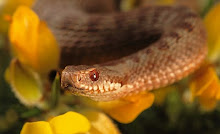
I showed them a couple of wild boar wallows and two adders before heading off to an old tawny owl haunt, hoping that he still occupied it? He wasn't there and it soon became evident as to why!
As I approached the roost I could see hornets buzzing in and out, and it wasn't until I got close that I realised they were actually building a nest.
Hornets build their nests in the spring, not autumn and it can only be the insane hot weather we have been seeing lately that provoked them to start building at the beginning of October.
The hornets typical behaviour in early autumn is to leave the nest to mate and shortly after mating the male hornet will die. Towards late October the workers and unfertilised queens also die just leaving the fertilised queens, which survive the winter.

Anyway, I wanted to get some pics and footage of them myself as I knew it wouldn't be long before they realised that autumn is on the way and would soon leave the partly built nest to mate. So I went back out to film and photograph them.
As I approached the nest they were buzzing around my head as they were flying in and out, so I approached with caution as just one sting would have sent out a pheromone, which would have mobilised the whole colony to attack. The sting from a hornet is far worse than that of a wasp, due to their size and venom yield, and as they have no barb on the stinger like the wasp, they can sting multiple times.

I was within a few feet of the nest and noticed a guard hornet sat at the entrance, watching me. As he kept his eye on me, he was also watching every single hornet enter the nest and it was fascinating to watch him rear up like a preying mantis if I got too close, or if a worker hornet got too close to him.

Here he is, watching me as I got as close as possible. Photographed using a 100mm macro lens from approx 6 inches away.


And here he is in all his glory; all 5cm of him!
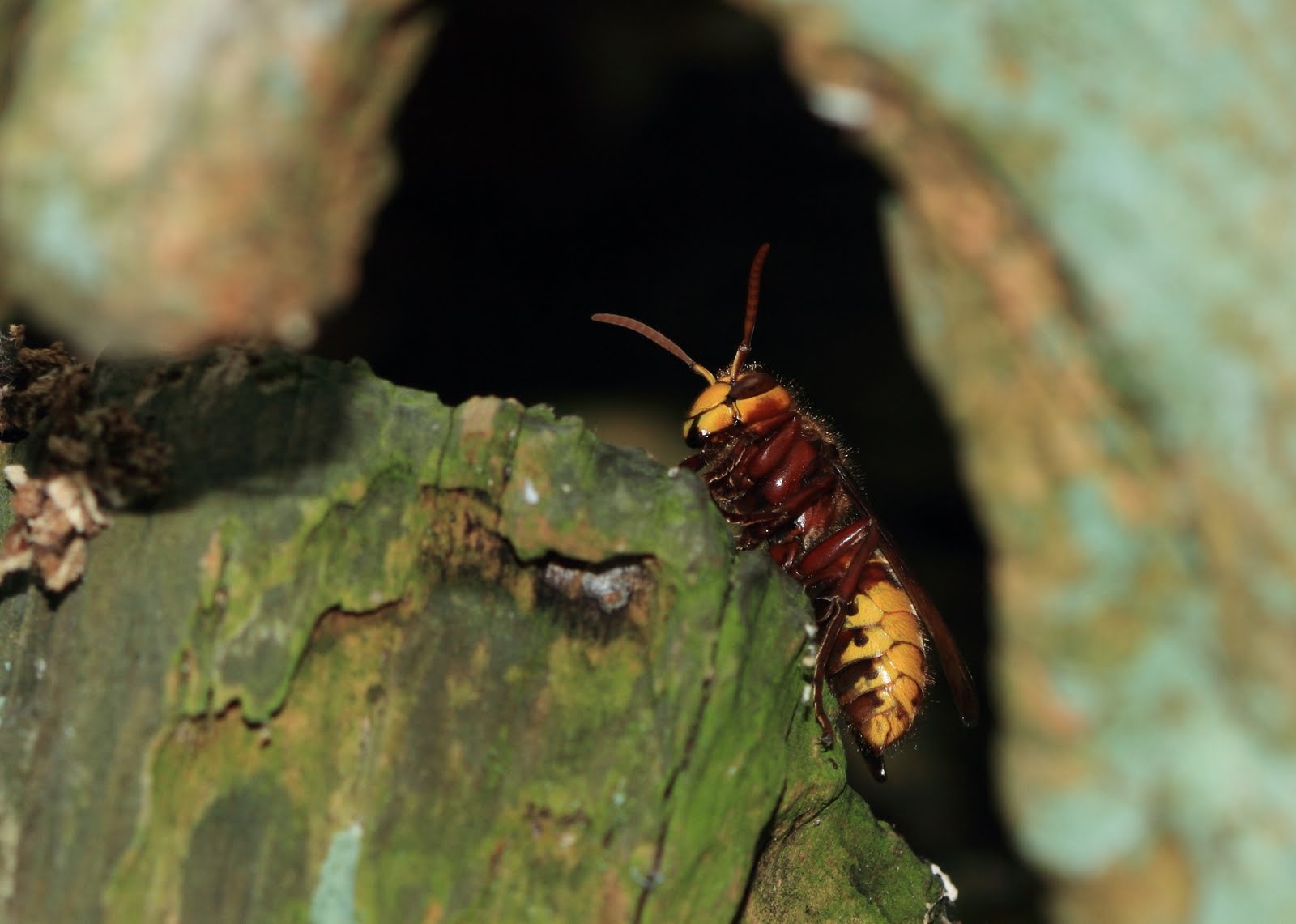


I had to stretch to grab a shot of the inside of the nest and this is when he reared up like a preying mantis, so it was a couple of quick shots before he told me off!


I then filmed them for around 45 minuets. You can watch the edited version below...
Hornet Film Here

Although I didn't get to film for Autumnwatch in person, I know that these hornets along with wild boar and possibly an adder will be featuring on the first show of the series on Friday 7th October. I hope they liked the varied wildlife I showed them and I also hope it will make for some interesting viewing, even though I have not heard from them since.
My time spent with them, helping to give some unique and unusual wildlife behaviour opportunities should have warranted a thank you at least? Maybe my name will appear in the credits as a special thank you, but I doubt it.
Sorry to finish on a duff note, but without people like me they would have to work a lot harder and probably wouldn't stand a chance of finding hornets building a nest in October!!!

Rob

"I recieved a text message from a member of the film crew thanking me for my time, helping them find the hornets, adder and wild boar wallow(s)."
It was a pleasure to help and would love the opportunity to help again in the future. It was a bit surreal watching it on TV!

Rob

Thursday, 29 September 2011

What a "Waste!"

If you live in the Forest of Dean and Wye Valley area, you will probably be aware that yet another white fallow buck has died!
Not from being involved in a collision with a car like the last one, but from discarded rope getting tangled in his antlers and then with a melanistic (black) bucks antlers as they fought, during rutting. Sadly the white buck died before he could be saved and as these animals are quite rare, it was very sad news.

Story Here

The white buck was a lot younger than the black buck and this would have meant he was not as strong, hence the reason why he perished first. If the two lads hadn't found them, the black buck would have perished also. Basically with a combination of factors ranging from stress, lactic acid build up and exhaustion, he didn't stand a chance and probably died from heart failure.
You can judge a buck's age from the size of his antlers and as you can see in the photograph, the white buck had significantly smaller antlers.

As many of you know, I write a wildlife column called Ward's Wildlife for a local newspaper, but I don't expect anyone can remember the very first article I wrote?
It was simply called "Fly Tipping" and it showed the consequences of what discarded material such as rope can have on our wildlife and environment.

Link to article on my blog as I can't find the original online. Warning, graphic photograph! Article Here

Some people just don't care and they don't give a damn about our wildlife. I know, I have met many of them in the forest over the years.
I just hope that when one of these people are eventually caught, the punishment will be an example to show the others that their behaviour is wrong and cruel, and will not be tolerated.
I urge everyone to report any fly tipping to me anonymously by email, thanks.

Rob

Friday, 23 September 2011

Great Response!

Following my recent column feature for Ward's Wildlife; "Volunteer for a Better Future", I am over the moon that 8 new volunteers have signed up to help Gloucestershire Wildlife Trust after reading my column.
This is great news and I am very pleased that I was able to help such a worthy cause.

Thank you to all who have already taken the step towards a better future for yourself and our wildlife!

Feature Here
Rob

Saturday, 17 September 2011

ITV West - Wild Boar

Click the link below for my recent TV slot with ITV West on the Wild Boar culling issue.
As part of a group I am petitioning DEFRA for seasonal protection for this animal. The majority of "my" filming was cut from the final piece as the Forestry Commission took over to try and justify the reasons for culling 12 months of the year.
As this piece was very biased, I will be filming myself to elaborate and put right the many errors and misguided comments from Ian Harvey.
This is not going away and there will be more. I have never been more determined about anything in my life and I will fight this until the end.

Watch this space.

Click Here for Film

Rob

Thursday, 15 September 2011

Monday, 12 September 2011

Wild Boar Update

I have just finished filming for ITV West; to be aired later this week after they have interviewed the Forestry Commission. The filming was to promote the need for seasonal protection for the boars. See reasons below and support us by signing the petition and joining our site. Thanks!
__________________________________

We have been living alongside wild boar in the Forest of Dean for the last seven years. During this time we have slowly seen and heard the scare tactics used by certain people, to gain support and justify the culling of this animal.
I don't know why these people feel they need to justify their actions as I, as an individual fully support the management of the wild boars, as I do with the deer. However, what I do not support is the culling of this animal all year round. The wild boars have an annual rut, which takes place near the end of November and after mating, the Wild boar sows have a gestation period of four months where she will not breed again.
All depending on the age and experience of the sow, she will usually give birth to between two and eight hoglets. These hoglets are dependant on the sows milk for three months and during this time the sow will not let "any" sexually mature male boars near her or her hoglets.
There has always been speculation that wild boars will breed all year round. This speculation is giving out false facts and making people think that as soon as they give birth, they breed again. I would like to point out to the powers to be, which think this is possible.... There are only 12 months in a year and for a wild boar to have two litters per year, there would need to be 14 months in a year!?!

The problem is that a lot of the studying and "so called" facts are coming from domesticated farmed animals, which have a food source supplied to them all year round. These are not wild animals like the boars we have living free in the forest, that have to rely on finding their own food.
One main concern is that the over culling of this animal will disrupt their normal breeding pattern. E.g. If a sows hoglets are taken out, natural instinct will tell the sow to breed again and the males will automatically oblige. This then puts an awful amount of stress on the sow as she has already endured four months of pregnancy and given birth.
This could lower her immune system and leave her susceptible to disease!

Now we must look at it from the hoglets point of view. If a sow, which has dependant young is taken out, the dependant hoglets will slowly perish without the support and nutrients they rely on from their mum.
If they are old enough to survive, they will have no experience, which would have been passed down from the sow. They will be living on their natural instincts, but this will not be enough for them in a world, which has changed since they last walked free here.
These orphaned hoglets will undoubtedly end up as either road kill, or as an easy target for the cull. Either way, this is not acceptable as a "correct management plan" exists to "manage" the population, not to shoot on sight as this is just glorified hunting.
The Forestry Commission recently estimated their to be between 200 and 350 wild boar in the Forest of Dean. That is one hell of a margin and this just proves that they have no idea "like everyone else" how many are actually here!
As already mentioned, I support the management of this animal, but only if it is done correctly and at present they are shooting on sight, an animal which they obviously know very little about.
If anyone from the Forestry Commission is reading this, let me share my one true reason with you as to why I am against your wild boar policy at present.

Firstly, you throw the scare tactics around like there is no tomorrow and you try and intimidate people to shut them up. The wild boar is a living creature that deserves and requires seasonal protection. If you can't control them with a closed season in place, I would just like to ask you where all the revenue is going from this once absent creature. You have killed way over 150 animals so far this year, so surely this has generated a substantial amount?
Why can't you have a "dedicated" team to manage them. I am sure the revenue generated would easily pay for the extra costs and with a closed season in place they will not be required on a full time basis all year round.
You have had 7 years to learn and manage these animals, yet in these 7 years it seems that you still know very little about them. Or is that you only print certain aspects from fear of being labeled as cruel? 7 years on and you still aren't putting the wild boars welfare first. They didn't ask to be here. It isn't their fault!
Only the other day, someone came up to me and said that if they were removed immediately when they were released, there wouldn't be a problem today.
You left them out there to breed, knowing what would happen and 7 years later you are still making excuses.

Like I said, these are living animals, which have dependant young. They are tight family units with strong bonds and "deserve" to be treated right!
I love all wildlife and as you know I work extremely hard with our native snakes each year. I never do anything for finantial gain as you also know and the wild boar mean no more or no less to me than any other living creature in the forest.
I will support you all they way, as long as they are being managed right and you put their welfare first.

Join our site... Friends of the Boar

Sign Petition here... Petition


Rob